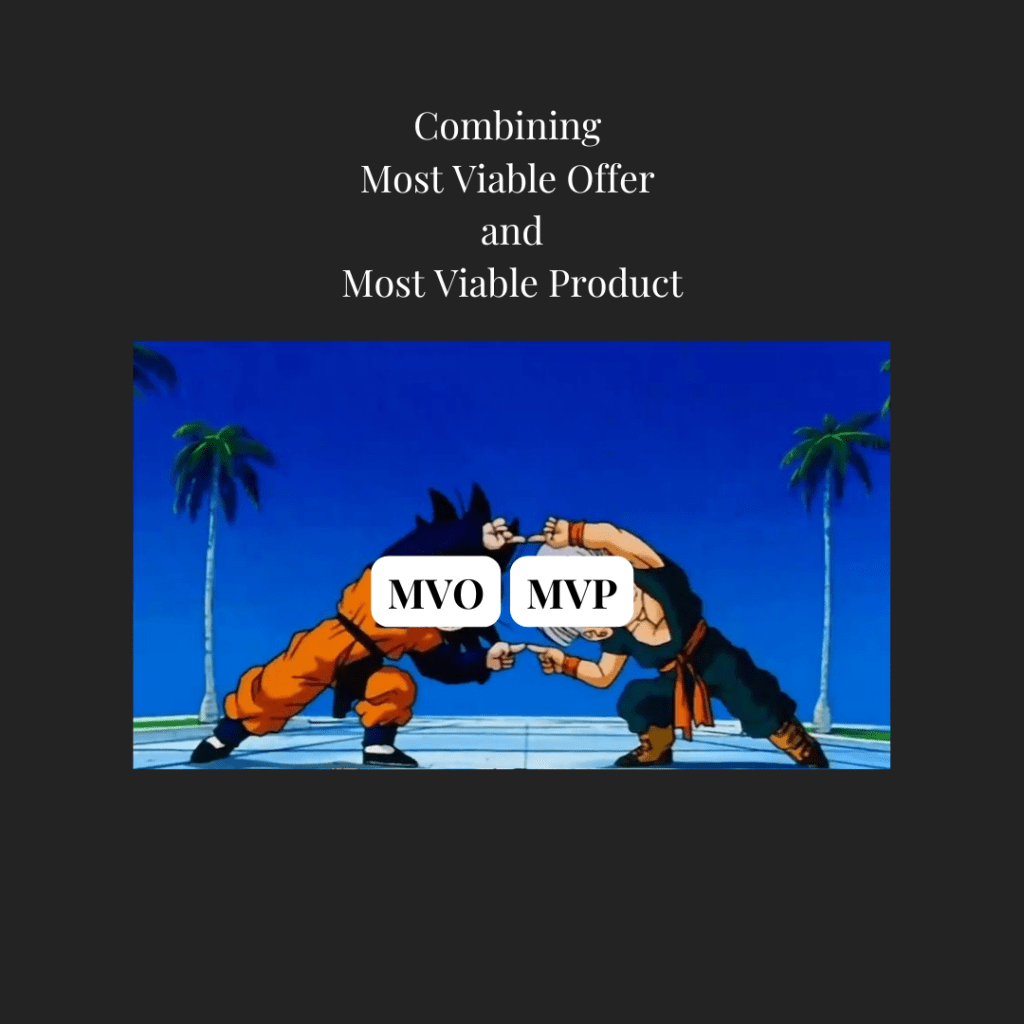
A Minimum Viable Offer is an offer that promises and/or provides the smallest number of benefits necessary to produce an actual value to the user. A Minimum Viable Offer is a prototype that’s been developed to the point that someone will pull out their wallet and commit to making a purchase. (from The Personal MBA)
A minimum viable product, or MVP, is a product with enough features to attract early-adopter customers and validate a product idea early in the product development cycle. In industries such as software, the MVP can help the product team receive user feedback as quickly as possible to iterate and improve the product. (from Product Plan)
These two seems similar but as you can see the MVO tells you to find the smallest number of benefits to produce and actual value, while MVP tells you to release a product early to receive user feedback quickly as possible and continue the iteration and improve the product.
The next challenge is to actually implement them into your work. The main issue is that some people strive for perfection. While working to produce perfection is a good trait to have, however you need to look at your environment, is striving for perfection on the early stage of a product or a feature a good idea?
Remember that what you’re about to launch is based on assumptions, and the launch is the only way to validate them. You’re still at risk of failing unless you already have a great amount of pre-orders and can meet your users’ expectations. In that case, striving for perfection might be justified.
But more often, we face a problem where something just lacks a bit of this and that which further delaying the launch. I’m not saying you should be reckless and launch whatever whenever you’re ready. What I’m saying is to find the most valuable aspect of your product so that people will pull out their wallets and commit to making a purchase. That’s the first step. If you find that your product should have X and Y, that’s a great idea, but start developing them after the core product or feature is stable.
Because even what you thought was the “MVO/MVP” of the product can still gain feedback from users and may have unforeseen problems too, it would be wise to stick to the MVP and MVO first and add the extras later on.
Use case example from implementing MVO/MVP is if you’re making a website for selling your clothes. is if you’re making a website for selling clothes. You need a stable and reliable product-to-purchase journey first before you’re going to meddle around another “nice-to-have” feature right? Examples of these features are a blog to boost your SEO or an in-web chatting system with bots/AI. These features should be focused on later, while you should concentrate all your resources on the MVO/MVP first.into the MVO/MVP first.
Another use case is if you’re in an organization. As a programmer myself, I have noticed that some changes are incremental but I am glad that my workplace understand the MVO/MVP, so while the changes are necessary but we know that it should be focused later on. We prioritize on what give the most value to our user first.
By consistently implementing MVO/MVP in your work, you’re not only giving your customers the best value, but you’re also maintain the pace of your resource so that your team keep developing what’s the most impactful for the organization, because at the end of the day what’s the most valuable to your costumer become the most impactful for your organization.






 Renaldi Adrian
Leave a comment