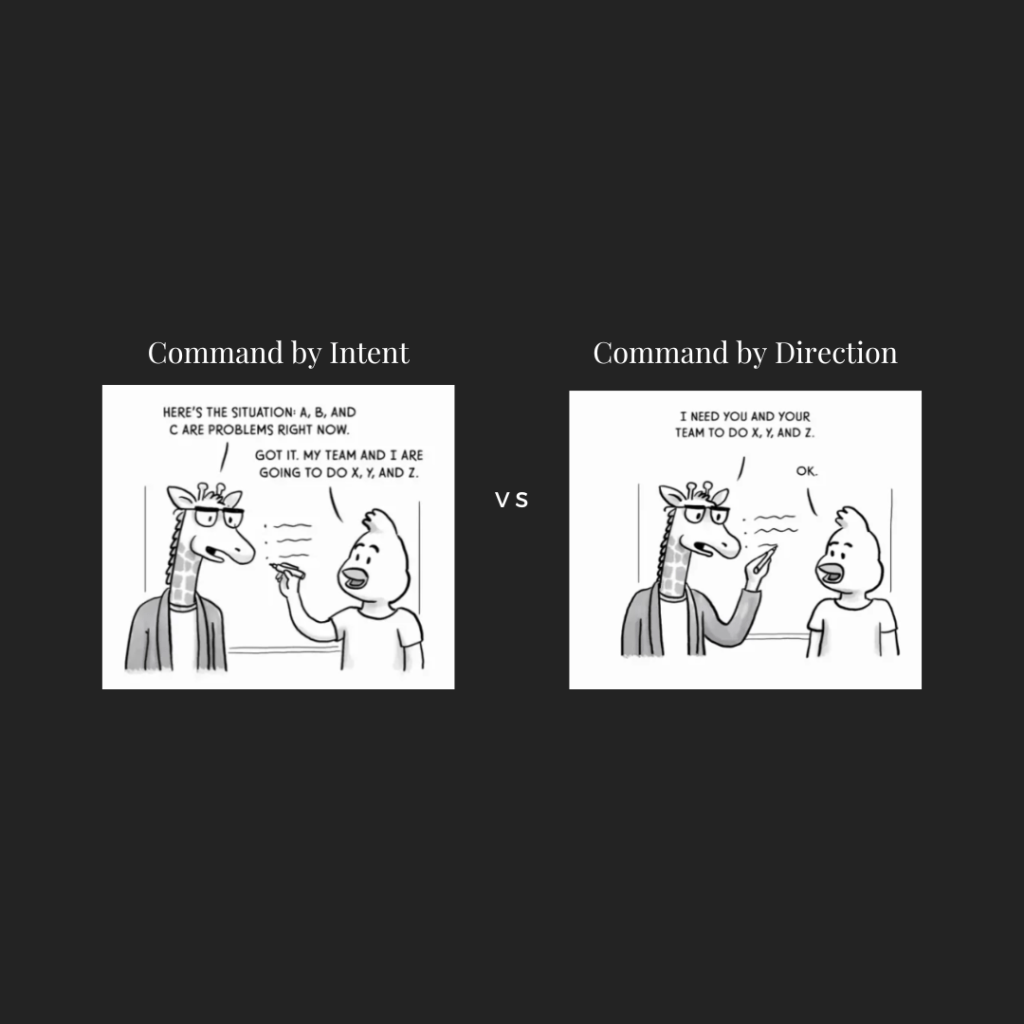
I had an experience in the early days of my 9-5 jobs when I worked as a backend engineer. After assigning a task, my boss would say, “It’s your playground, do what you want.” It sounded strange to me because I was used to doing things that were clearly instructed. In my previous job at an IT software house, we only did what was explicitly told to avoid misexpectations from the client. But this was different now. I realized that by understanding your job as your playground, you break the limits of what you thought was impossible. This was one of my first experiences receiving a command by intent.
Fast forward, I moved to another company, and the boss there said, “Go wild,” which I understood immediately, thanks to my past experience.
Then I started studying the different ways of giving commands, from software house to corporate or startup. Why does one command by direction and the other by intent? What’s the benefit between these two command type?
Upon further study, I noticed that the term “command by intent” is usually used by military organization. The primary goal of Command by Intent is to improves agility of military operations by allowing exploitation of local opportunities without an explicit directive from the commander to do so, compared to command by direction, every step or actions are explicitly direceted from the commander to do so.
The example use case of command by direction is quite easy as you’ve probably experienced it too, you’re just being told to do X, no more, no less. This doesn’t always mean a bad thing, it’s not supressing creativity per se, because there are just some job that need this command type, it’s best to use command by direction where the output of the project have to be exactly meet the client’s specifications, as shown in my experience on software house, because even when you do more, the client’s prespective might be different from you, what you thought might be a good idea may not be seen as such by your client, and you might just be adding more conflict to the project.
On the other hand, if you’re working in a corporate or a startup, implementing command by intent is significantly beneficial for you and your team, as a corporate or startup, the product that you’re working in will have to constantly growing, It will always need to cater to the new needs of your users, or you may introduce novelty to your product. The benefit of implementing command by intent is significant in a corporate or startup environment.
To actually implement command by intent, you need to bring everyone on your project team together to discuss three things: background & problem, possible solutions, and what will be measured to determine the project’s impact.
You can see the difference between command by intent and command by direction in their implementation. With command by intent, you’re not exactly directing your team, you’re giving them ideas, and encouraging them to share their own ideas too. Do you know that humans inherently want to do things based on their own ideas rather than on others’ ideas? By involving them in the project’s initiation, you’ll get the best output from your team.
Just remember to keep in touch with your team throughout the project. Hold meetings biweekly or monthly for accountability. Accountability help them realize the responsibility they’re going through and you might opportunities for feedbacks along the way.
As Benjamin Franklin said, “Tell me and I forget, teach me and I may remember, involve me and I learn.” Your team’s growth is your growth too.







 Renaldi Adrian
Leave a comment